

Samsung Washer Repair in San Diego, CA
San Diego's hard water from regional sources leaves mineral deposits that accumulate inside washing machine components over time, making Samsung washers particularly prone to scale buildup that affects performance and longevity. Hunt Appliance Repair connects San Diego property owners with local independent repair providers who can address these water-related issues and other Samsung washer problems quickly, so you're not without a working machine for long.
Samsung Washer Repair for San Diego Homeowners
San Diego's hard water supply creates unique challenges for washing machines, particularly Samsung models that rely on precise water chemistry to operate efficiently. Mineral buildup accumulates in valves, hoses, and drum seals over time, reducing wash quality and forcing the machine to work harder than it should. Combined with occasional electrical stress from older neighborhood power infrastructure, Samsung washers in San Diego homes face real wear that demands timely attention. What begins as spotty cleaning or slow drains can escalate into costly component failures if left unaddressed.
Hunt Appliance Repair connects San Diego homeowners with independent local providers who understand Samsung washer systems and the specific pressures they face in this region. Rather than guessing at the problem, these providers diagnose the root cause—whether mineral deposits, electrical issues, or mechanical wear—and explain repair options clearly. Follow-up support ensures the machine runs reliably and that you know how to maintain it going forward. When your Samsung washer needs repair in San Diego, a straightforward local connection means faster service and peace of mind.
Common Samsung Washer Error Codes
Samsung documents these twelve codes most often on washers. Seven typically trace to something simple — a blockage, a latch, a setting — and five to a component that needs replacing.
Samsung Washer 4C
Often clearable without a technician
What it means: The washer asked for water and did not get what it expected, so it has stopped rather than run a cycle dry. Samsung shows this as 4C on newer panels, 4E on older ones and nF on some models — one fault, three displays.
Why it happens: Almost always something before the machine rather than inside it: a supply tap not fully open, a kinked fill hose behind the unit, or the small mesh screens where the hoses meet the washer silted up with scale and grit.
What you can check: Check both taps are fully open, then pull the machine out far enough to see the fill hoses are not kinked. If that looks fine, turn the taps off, unscrew the hoses at the machine end and look at the inlet screens for debris.
When to call someone: If the supply is good and the screens are clear, the inlet valve on the machine is next, and that is where it stops being an owner check.
Samsung Washer Ub
Often clearable without a technician
What it means: The load has gone off balance in the tub and the washer will not spin it at speed, because an unbalanced drum at spin speed can damage the machine.
Why it happens: Usually one heavy item on its own — a towel, a bath mat, a single pair of jeans — or a load that has twisted into a rope on one side of the drum.
What you can check: Open the door, redistribute the load by hand and restart the spin. Adding a couple of similar-weight items often settles it; washing one heavy item alone rarely spins well.
When to call someone: If it trips on every load including well-balanced ones, the suspension or the sensor reading the drum may need looking at.
Samsung Washer 4E
Often clearable without a technician
What it means: The same not-filling fault as 4C, shown as 4E on older Samsung panels.
Why it happens: A closed or partly closed tap, a kinked fill hose, or blocked inlet screens where the hoses connect.
What you can check: Work from the wall in: taps fully open, hoses unkinked, then the inlet screens at the machine end.
When to call someone: If water reaches the machine freely and it still will not fill, the inlet valve needs testing.
Samsung Washer SE
Often clearable without a technician
What it means: Water is not leaving the machine at the rate the cycle expects, or is not leaving at all. Shown as 5E, SE, 5C or nd depending on the panel.
Why it happens: The debris filter at the bottom front catches coins, hair grips and lint and eventually packs solid. A kinked drain hose or a standpipe that cannot take the flow does the same thing from further down the line.
What you can check: Open the small flap at the bottom front, drain the residual water into a tray and clean the filter. Then check the drain hose behind the machine for kinks and that it is not pushed too far into the standpipe.
When to call someone: If the filter is clean and the hose run is clear, the drain pump itself needs testing.
Samsung Washer UE
Often clearable without a technician
What it means: The same unbalanced-load condition as Ub, shown as UE on some Samsung models.
Why it happens: A single heavy item, or a load that has bunched to one side of the drum.
What you can check: Redistribute the load by hand and restart the spin.
When to call someone: If balanced loads also trip it, the drum suspension is worth checking.
Samsung Washer dC
Often clearable without a technician
What it means: The washer cannot confirm the door is shut and locked, so it will not start or will stop mid-cycle.
Why it happens: Most often laundry caught in the door seal stopping it closing flush, or a door that has been slammed rather than pushed shut.
What you can check: Open the door fully, clear anything caught around the seal, and close it firmly without forcing it. Check the latch and the strike plate for anything obstructing them.
When to call someone: If nothing is obstructing it and the lock still will not engage, the door lock assembly is the usual cause.
Samsung Washer SUd
Often clearable without a technician
What it means: The washer has detected far more foam than the drum is designed to handle, and is pausing to clear it before continuing.
Why it happens: Usually too much detergent, or a standard detergent used in a high-efficiency machine, which foams several times more than an HE formula.
What you can check: Let the machine run its own suds-clearing routine rather than cutting the cycle short. Next load, reduce the dose and check the detergent is HE-rated if your machine needs one.
When to call someone: If it appears with a correct HE dose, something may be holding water in the drum and it is worth having checked.
Samsung Washer 5C
Often clearable without a technician
What it means: The same not-draining fault as 5E and SE, shown as 5C on some Samsung panels.
Why it happens: A packed debris filter at the bottom front, a kinked drain hose, or a standpipe that cannot take the flow.
What you can check: Clean the filter behind the flap at the bottom front, draining the residual water into a tray first, then check the hose run behind the machine.
When to call someone: If the filter is clean and the hose is clear, the drain pump needs testing.
Samsung Washer nF
Often clearable without a technician
What it means: The washer is not filling — the same fault Samsung shows as 4C and 4E on other panels.
Why it happens: A tap that is not fully open, a kinked fill hose, or the inlet screens where the hoses meet the machine blocked with scale and grit.
What you can check: Check both taps, straighten the hoses, then turn the taps off and inspect the inlet screens at the machine end.
When to call someone: If water reaches the machine freely and it still will not fill, the inlet valve is next.
Samsung Washer OE
Usually needs a technician
What it means: There is more water in the tub than there should be, so the washer has stopped filling and is trying to pump out.
Why it happens: Normally the inlet valve passing water when it has been told to close, rather than anything to do with the load or detergent.
What you can check: Turn the supply taps off at the wall so no more water can arrive. There is no owner-side fix for a valve that will not shut.
When to call someone: Promptly — a valve stuck open is a flood risk as well as an error code.
Samsung Washer 0E
Usually needs a technician
What it means: The same overfill condition as OE, shown with a zero on some panels.
Why it happens: An inlet valve letting water through when it should be closed.
What you can check: Shut the taps at the wall to stop the fill. Nothing else here is an owner check.
When to call someone: Promptly, for the same reason as OE.
Samsung Washer ddC
Often clearable without a technician
What it means: The AddWash door — the small hatch in the main door — is not registering as closed and latched.
Why it happens: It is easy to push shut without seating the catch, and a trapped sock or glove will stop it closing flush.
What you can check: Open the AddWash door fully, clear anything caught in it, and press it closed until the catch engages.
When to call someone: If it is properly shut and still reads open, the hatch switch needs checking.
Samsung Washer HE
Usually needs a technician
What it means: A fault in the heater circuit, so the machine cannot bring the wash water up to the temperature the cycle asked for.
Why it happens: A component failure rather than anything that builds up, so it usually appears without warning.
What you can check: Nothing here is an owner check — the heater and its circuit are inside the machine.
When to call someone: When you see it. Cold-water cycles may still run, but the machine is not doing what the programme selected.
Samsung Washer 5E
Often clearable without a technician
What it means: The same not-draining fault Samsung shows as SE and 5C on other panels.
Why it happens: A packed debris filter at the bottom front, a kinked drain hose, or a standpipe that cannot take the flow.
What you can check: Open the flap at the bottom front, drain the residual water into a tray and clean the filter, then check the hose run.
When to call someone: If the filter and hose are clear and it still will not drain, the drain pump needs testing.
Samsung Washer LE
Usually needs a technician
What it means: Moisture has been found somewhere inside the machine it should not be — a leak, not a setting.
Why it happens: Water escaping from a hose connection, a seal or the tub reaches a sensor that shuts the cycle down.
What you can check: Turn the supply taps off at the wall and stop using the machine. The code says water is escaping but not from where.
When to call someone: This needs a technician — tracing the source means getting behind or under the machine.
Samsung Washer 3E
Usually needs a technician
What it means: A motor fault — the drive is not behaving the way the control expects.
Why it happens: A failure in the motor or its control circuit rather than anything to do with the load or detergent.
What you can check: Nothing here is an owner check. A single power-cycle at the breaker clears a one-off glitch; a code that returns is real.
When to call someone: If it comes back after a power cycle, the motor circuit needs testing.
| Code | What it means |
|---|---|
| Ub / UE / U6 | The load is unbalanced inside the tub, so the washer cannot spin it safely. |
| 5E / SE / 5C / nd | Water is not draining at the rate it should, or is not draining at all. |
| dC / dC1 / dL | The door is not being detected as closed and locked, so the cycle will not run. |
| SUd / Sd | An over-sudsing condition has been detected and the machine is pausing to let the foam clear. |
| OE / 0E / OC | There is too much water in the washer, which normally means the inlet valve is passing water when it should be shut. |
| LE / 1C | Moisture has been detected somewhere inside the machine that it should not be, which is a leak rather than a setting. |
| HE / HC | A fault in the heater circuit, so the machine cannot bring the water up to temperature. |
| 3E / 3C | A motor fault — the drive is not behaving as the control expects. |
| tE / tC | The temperature sensor is reporting a reading outside the range the cycle allows. |
| bE2 / 6E2 | A button on the control panel is reading as stuck or continuously pressed. |
Don't see your code? Call (619) 558-2886 — we'll help you track it down.
Common Samsung Washer Problems We Fix
Won't Drain Water
A clogged drain hose, pump filter debris, or faulty drain pump often prevents water from leaving the tub. The independent provider Hunt Appliance Repair connects you with will diagnose the blockage or component failure and restore proper drainage.
Leaking Water
Worn door seals, loose hose connections, or internal tub cracks commonly cause leaks during or after a wash cycle. A local provider will locate the source and repair or replace the leaking part to stop water damage.
Not Spinning or Agitating
A broken drive belt, faulty motor, or worn clutch assembly can prevent the drum from spinning. The independent provider you're connected with will test the motor and replace worn parts to restore proper wash action.
Error Code on Display
Samsung washers display error codes like 4C to signal drainage issues, sensor faults, or electrical problems. A local repair provider will read the code, identify the underlying cause, and perform the needed repair or replacement.
Loud or Vibrating Excessively
Drum bearing wear, foreign objects in the tub, or an unbalanced load create noise and vibration during operation. The independent provider will inspect the drum and bearings, remove debris, and repair damaged parts to quiet the machine.
Won't Start or Respond
A failed control board, faulty door latch, or power supply issue can prevent the washer from starting. The local repair provider you're connected with will test electrical components and replace the faulty part to restore operation.
Why San Diego Homeowners Choose Hunt for Samsung Washer Repair
Local Samsung Washer Repair Technicians
Hunt connects you with independent Samsung washer repair providers right in San Diego. Fast response times mean your laundry backup doesn't linger. Local expertise saves time and gets your machine running again quickly.
Clear Samsung Washer Repair Communication
When your Samsung washer breaks down, confusion makes it worse. Hunt's process keeps you informed at every step—what's wrong, what's needed, and what happens next. Straightforward updates mean no surprises.
Samsung Washer Repair Done Right
Samsung washers are built to last, but they need proper care when repairs happen. Hunt's independent providers diagnose your machine thoroughly and address the real problem, not just the symptom, so the fix holds.
San Diego's Hard Water & Samsung Washers
San Diego's water mineral content accelerates buildup inside washing machines, affecting performance and lifespan. Independent Samsung washer repair providers connected through Hunt understand how local water conditions stress your appliance and keep that in mind during service.
How Our Repair Service Works
Schedule Your Samsung Washer Repair Visit
Contact Hunt Appliance Repair to describe your Samsung washer issue—whether it's a leak, cycle failure, or drainage problem. We'll connect you with a local San Diego provider who can arrange a time that works for your schedule.
Technician Diagnoses Your Samsung Washer
The independent repair provider inspects your Samsung washer to identify the root cause. San Diego's hard water supply can accelerate mineral buildup inside Samsung washers, so the technician will check for scale-related issues alongside electrical and mechanical components.
Complete Samsung Washer Repair & Follow Up
Once the repair is finished, the technician will test your Samsung washer to confirm it's working properly. You'll receive details about what was repaired so you understand your washer's condition going forward.
Need appliance repair in San Diego? Our technicians can help fast.
Call (619) 558-2886Samsung Washer Repair Across San Diego
San Diego's water supply carries minerals from the Colorado River and State Water Project sources that leave deposits inside appliances over time. Samsung washers in homes throughout the region—from established neighborhoods like North Park to newer communities such as Rancho Bernardo—face accelerated scale buildup in their fill valves, hoses, and drum seals. This mineral accumulation reduces water flow, forces the motor to work harder, and can trigger error codes or early wear on internal components. Addressing scale-related issues promptly helps prevent costlier damage down the line.
Older grid infrastructure in some San Diego neighborhoods can also subject washers to occasional electrical stress, particularly during peak demand periods. Combined with the region's hard water conditions, this makes routine maintenance and quick repairs especially valuable for keeping a Samsung washer running reliably. Hunt Appliance Repair connects you with independent local providers who understand these regional factors and can diagnose whether your washer's issues stem from mineral buildup, electrical sensitivity, or mechanical wear.
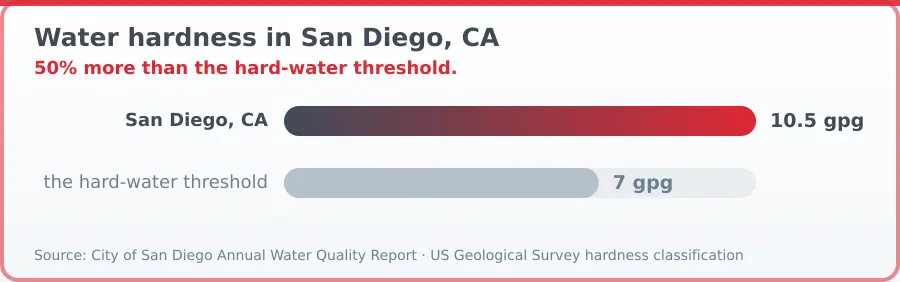
| Location | Water hardness vs the hard-water threshold (gpg) |
|---|---|
| San Diego, CA | 10.5 |
| the hard-water threshold | 7 |
Source: City of San Diego Annual Water Quality Report · US Geological Survey hardness classification. Retrieved October 27, 2026.
Samsung Washer Repair FAQ — San Diego, CA
Samsung Washer Repair addresses issues like drum problems, drainage failures, control board malfunctions, and seal leaks. A local independent provider will diagnose the fault, replace worn or broken parts, and test the machine before returning it to service. The scope depends on what's causing the malfunction—some repairs are straightforward, others require more time and parts sourcing.
Hunt Appliance Repair connects you with independent local providers across San Diego who typically respond quickly to repair requests. Many technicians can schedule visits within days. Response times vary by provider availability and your location—whether you're in central San Diego or neighborhoods like La Jolla or Point Loma—but local coverage means shorter wait times than regional services.
Repair pricing depends on the specific problem, replacement parts needed, and labor time. A simple fix like replacing a drain hose costs less than fixing an internal drum bearing or control board. The independent provider you're connected with will assess the washer and discuss costs before starting work. Parts availability and the model's complexity also play a role in final pricing.
Take note of any error codes on the display, describe when the problem started, and document what the washer does or doesn't do—whether it fills, drains, spins, or makes unusual sounds. Clear space around the unit so the technician can access it safely. Let the provider know if the washer is still under warranty. Having this information ready helps the repair go smoothly.
Use the correct detergent amount and type for your model, avoid overloading, and leave the door open between cycles to prevent mold and odor buildup. Empty pockets before washing. Regular use of the cleaning cycle helps. These habits reduce strain on internal components and extend your washer's working life.
San Diego's water supply tends toward hardness, which can cause mineral scale buildup inside washing machines over time. This buildup affects fill valves, hoses, and internal components, potentially leading to poor performance or failure. Running a washing machine cleaning cycle periodically and considering a water softener can help protect your Samsung washer from scale-related damage in the San Diego area.
More Ways We Can Help
More Repairs for This Brand
Homeowner Safety Toolkit
Confirm Who You're Hiring in San Diego, CA
Before you hire anyone, use these independent national resources to confirm credentials, standards, and track record.
ISCET
NASTeC is the appliance repair industry's own national certification exam, administered by the nonprofit ISCET. It's voluntary, so it's worth asking whether your technician holds it.
About NASTeC CertificationEPA
Anyone who services a refrigerator, freezer, or other appliance containing refrigerant is legally required to hold EPA Section 608 certification. See what that actually requires.
Refrigerant Certification RulesNFPA
A poorly repaired dryer, range, or water heater is a real fire risk. The National Fire Protection Association's home safety guidance covers what to check after any appliance service.
Appliance Fire Safety TipsBook your San Diego appliance repair today.
Call (619) 558-2886Our San Diego, California Service Area
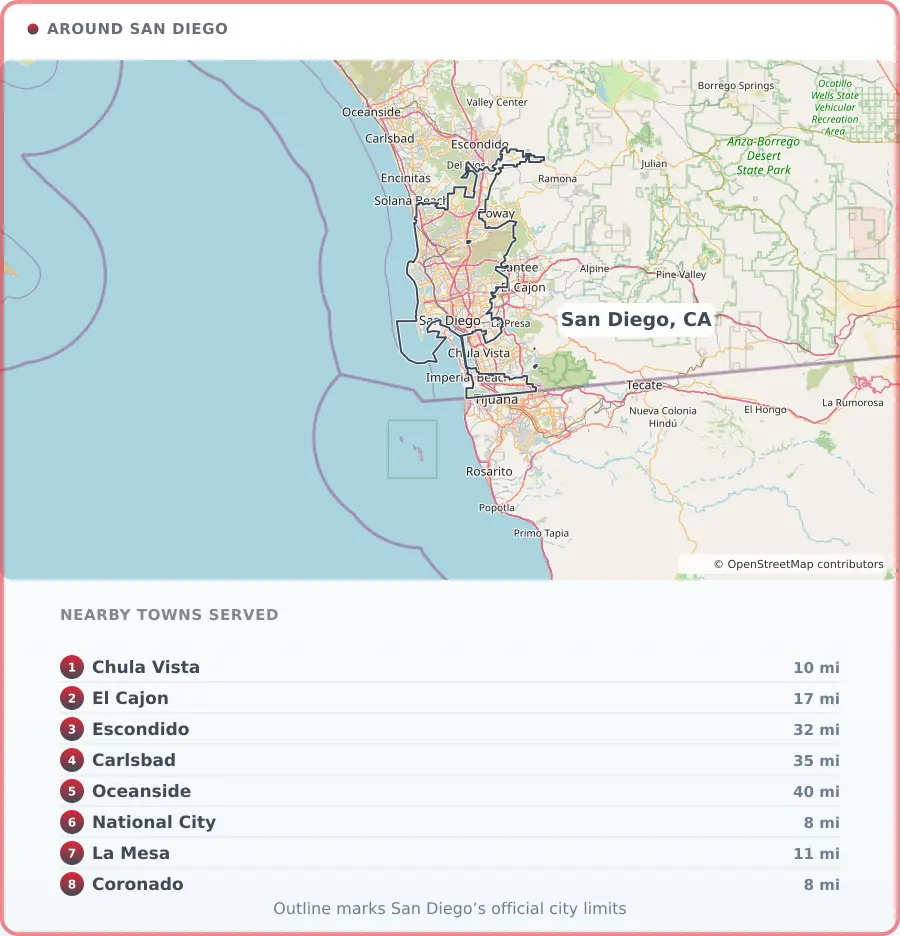
San Diego, CA is the centre of the service area, which extends to 8 surrounding towns. The map shows how far that reaches.
San Diego, CA at a Glance
San Diego stretches along California's southern coastline, where naval piers, research labs, and beach boardwalks share the same skyline. With roughly 1.39 million residents, it's a city built on a layered economy: a major U.S. Navy presence anchors the harbor, while a globally respected biotech and life sciences cluster thrives alongside UC San Diego's research engine. Add in tourism drawn by the beaches and climate, plus telecommunications, defense contracting, and healthcare systems like Sharp and Scripps, and you get a town that's equal parts military, scientific, and sun-soaked.
Neighborhoods like La Jolla and North Park show off the city's range, from coastal calm to walkable, creative energy. It's a place where innovation and ease of living genuinely coexist, and homeowners here value service that moves at the same steady, dependable pace as the city itself.
Photo: Dirk Hansen, CC BY-SA 3.0